Artificial Intelligence is more of a reality than a concept that needs execution in the future. AI agents are rising fast in 2026, powering autonomous systems from e-commerce shoppers to business automators. Lately, Walmart's voice-buying bots have turned heads with their ability to take care of full purchases.AI agents have evolved from simple rule-based systems into intelligent, adaptive decision-makers. Some of them turn out to be decision-making smarts, while others can survive while handling complex real-world tasks.
An AI agent is a system that perceives its environment, makes decisions, and takes actions to achieve specific goals autonomously.
For businesses like a digital marketing company in Vadodara, understanding the types of AI agents isn’t just academic curiosity. It’s strategic knowledge. Knowing how these agents work can help brands automate smarter, personalize better, and compete more effectively.
Let’s get started.
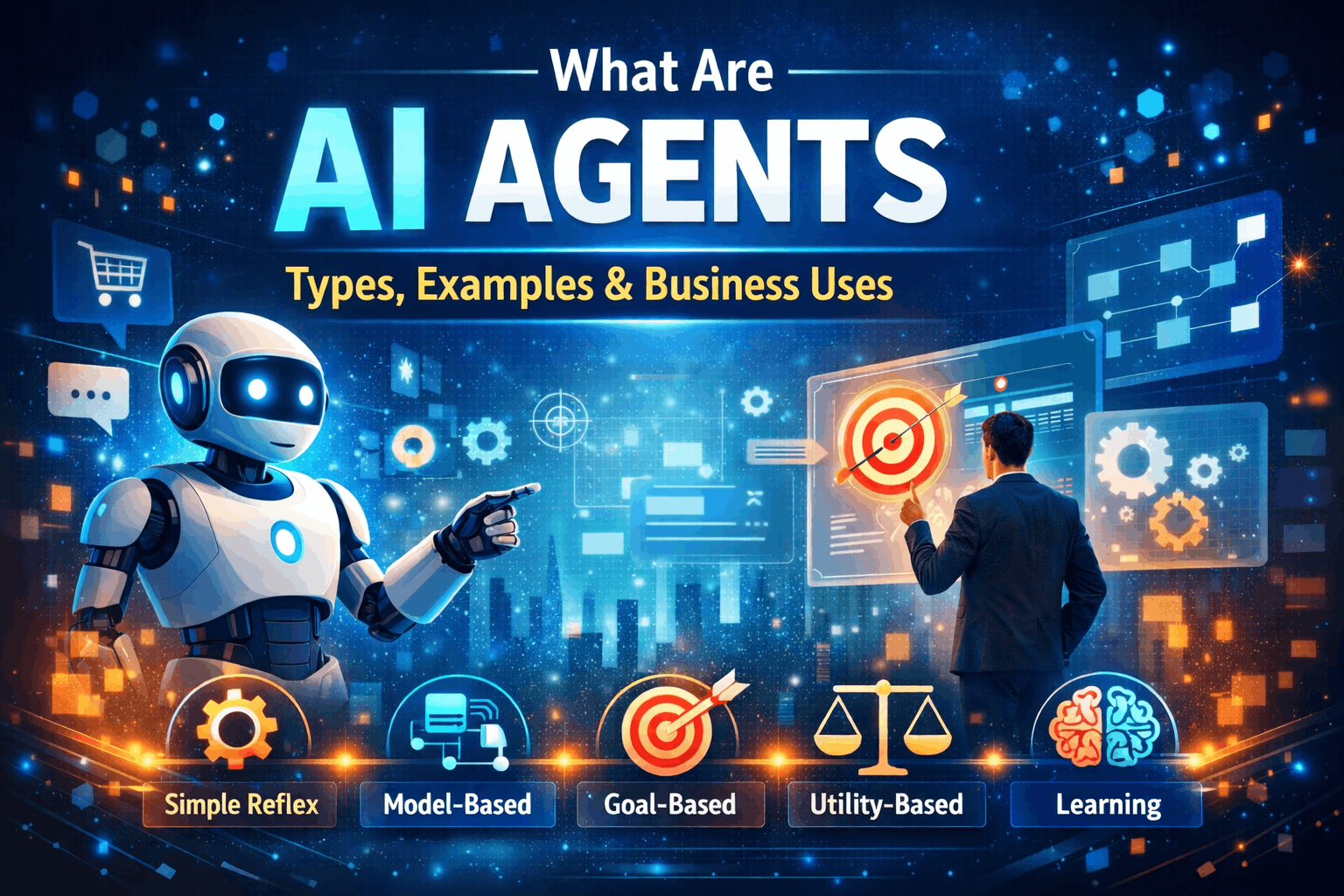
1. Simple Reflex Agents
2. Model-Based Reflex Agents
3. Goal-Based Agents
4. Utility-Based Agents
5. Learning Agents
Let’s begin with the most basic type:
Think of these agents as rule-followers. They operate on a straightforward “if this, then that” principle.These agents operate using predefined rules and respond only to current inputs without considering past or future data. They simply react to the present situation based on predefined rules.
Imagine a motion-sensor light. If movement is detected, the light turns on. If there’s no movement, it stays off. That’s a simple reflex agent in action.
- Simple reflex agents function using:
- Current input (what’s happening right now)
- Condition-action rules (predefined instructions)
They do not store memory. They do not analyze patterns. They do not adapt.
For example:
If a user clicks “forgot password,” send a reset email.
If website traffic spikes, trigger an alert notification. If the temperature exceeds 75°F, turn on the cooling system. The logic is immediate and direct.
- Fast response time
- Easy to design
- Cost-effective
Reliable for predictable environments
- Cannot learn from experience
- Cannot handle complex decision-making
- Struggles in unpredictable scenarios
In digital marketing in Vadodara, simple reflex agents can be used thoroughly. Basic chatbots that respond to keywords, Automated email responders, Pop-ups triggered by user actions, and Rule-based ad bidding systems.
They’re not flashy, but they’re effective. Sometimes, simplicity wins. Not every task requires deep intelligence. If you just need something to respond quickly and consistently, this type of agent gets the job done.
Now let’s level up.
Model-based agents improve decision-making by storing past data and maintaining an internal representation of the environment. They have their own internal models of the world, which help them make better decisions based on previous data.
If simple reflex agents live in the present moment, model-based agents carry a memory notebook.
- Current input
- Previous states
- Internal representation of the environment
This internal “model” helps them understand situations that aren’t fully visible.
- Better decision-making in partially observable environments
- Improved context awareness
- More reliable than simple reflex agents
- Still rule-based
- Limited flexibility
- Cannot independently create goals
In the Digital Marketing model-based agents are extremely useful in CRM systems, tracking customer history, Retargeting campaigns based on browsing behavior, and chatbots maintaining conversation context.
For example, if a user visits your pricing page three times in a week, a model-based agent can trigger a special offer email. It’s not guessing. It’s acting on stored behavior data.
These agents form the backbone of many marketing automation platforms. They bridge the gap between basic automation and intelligent personalization.
Suppose your goal is to increase sign-ups by 20% during the upcoming quarter. Here, a goal-based AI agent can analyze different strategies--adjusting ad targeting, refining landing pages, tweaking bidding strategies, and recommending or implementing changes that move you closer to that target. This is where marketing shifts from reactive to proactive.
If goal-based agents ask, "Does this action help me reach the goal?" utility-based agents ask, "Which action gives the best overall outcome?" They don't just focus on achieving a goal--they evaluate quality. Let's say your goal is to buy a laptop. A goal-based agent would help you find one. A utility-based agent would compare price, performance, battery life, brand reliability, and customer reviews--and then recommend the best overall option based on your preferences.
Imagine running ads across Google, Meta, and LinkedIn. For a firm like Consumersketch.in, a utility-based agent can analyze cost per click, conversion rates, audience quality, and return on ad spend—and allocate budget dynamically for maximum overall performance.
This is where data truly becomes a competitive advantage.
Now we arrive at the most sophisticated type: Learning Agents.
These agents improve over time. They don’t just follow rules or pursue goals—they adapt based on experience.
If the previous agents are employees following instructions, learning agents are employees who observe, experiment, and refine their approach every day.
A learning agent typically includes a learning component that improves performance, in addition to a performance element, a critic, and a problem generator.
In simple terms, they take action, observe results, learn from feedback, and adjust future behavior. For example netflix improving recommendations, spam filters are getting better over time, and predictive text is adapting to your writing style.
- Continuous improvement
- Adaptability
- Handles dynamic environments
- Requires large data sets
- Needs monitoring
- Can make unpredictable choices if poorly trained
In Digital Marketing, Learning agents are transforming marketing through AI-driven personalization engines, predictive analytics, automated content optimization, dynamic pricing systems, and customer behavior forecasting.
For instance, an AI-powered email marketing tool can learn which subject lines perform best with different audience segments and automatically adjust future campaigns.
Over time, performance improves without manual intervention.
That’s powerful.
AI agents aren’t theoretical concepts—they’re already embedded in everyday business operations.
Here are some practical examples:
|
|
|
|
|
|
|
|
|
|
|
|
|
|
|
|
|
|
|
|
|
|
|
|
|
|
|
|
|
|
Understanding the types of AI agents isn’t just for developers or tech enthusiasts. It’s essential knowledge for modern businesses navigating a competitive digital landscape.
From simple reflex agents that handle straightforward tasks to advanced learning agents that adapt and evolve, each type plays a unique role in automation and decision-making.
As digital ecosystems grow more complex, businesses that leverage the right type of AI agent will operate faster, smarter, and more efficiently.
The question isn’t whether AI agents will shape the future of marketing. They already are.
The real opportunity lies in understanding which type fits your business goals—and using it strategically.
Because in today’s world, intelligence isn’t optional. It’s operational.
An AI agent is a system that perceives its environment and takes actions to achieve specific goals.
Simple reflex agents are the most basic type, reacting only to current inputs.
No, only learning agents improve their performance based on experience, data given to them, and many other factors.
They are used in chatbots, ad optimization, personalization, analytics, and automation tools, in addition to operations, such as HR operations, SEO, and so on.
Goal-based agents focus on achieving a target, while utility-based agents choose the best possible outcome among options.